
Greece
Drakos–Selinitsa (Agios Dimitrios)
- Max depth56 m
- CertificationFull cave
- SpecialSidemount
Diving and fills
Dive here with
No dive centre guides here yet. Do you dive here with guests? Add your centre for free →
What it looks like
All 1 videos and posts
Videos and posts
From other divers, via YouTube, Instagram and Facebook. They only load when you click; after that, Google's or Meta's privacy rules apply.
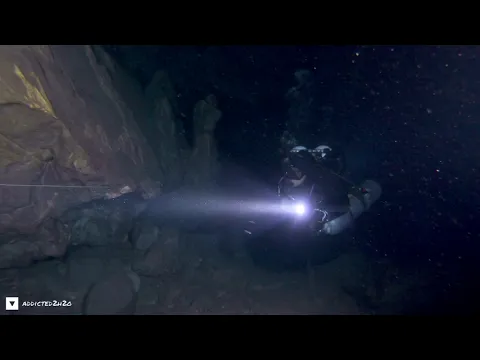
Videos shown with permission from the channel @addicted2h2o ↗
Search for more onYouTube ↗Instagram ↗Facebook ↗
Other people's footage, not advice: how someone else dives here says nothing about what suits your team. Dive within your training.
The dive
Behind the entrance waits a large antechamber with a huge stalagmite, proof that this part once lay above the sea.
Profile and sections
Behind the entrance waits a large antechamber with a huge stalagmite, proof that this part once lay above the sea. After the first 150 m the scenery changes: fewer side passages, clearer water and, instead of sharp rock, a sandy floor between walls smoothed by the water. About 250 m from the entrance there are gours with rare helictites. A light current towards the sea helps you on the way out, and the rocky floor keeps the visibility good (Grafas).
Drakos means 'dragon': in winter, when high flow, bad weather and a sea about a metre higher come together, water sprays far out of the entrance with a loud roar. The spring is the outflow of Selinitsa or Katafygi ('refuge'), a dry river cave on the shore. German, British, Czech and Greek divers explored both caves between 1980 and 1985; from 2000 the Greek group SPELEO took up the work and in November 2004, after five years and 25 expeditions, found the last 200 m of the connection. The whole system is ~4 km long (SPELEO; showcaves.com: 3.5 km), the fourth-longest in Greece.
Practical: the dry Selinitsa cave can be visited free and without a guide; bring a torch. showcaves.com advises staying within the first 300 m.
- Depth and profile
- Two entrances at -10 m (NPC 1982: -6 m) into a large antechamber. The first ~150 m are narrow and twisting; then passages 5–6 m wide drop over ~150 m to a main junction at -37 m, and to the north-west the cave rises again to -25 m at ~450 m from the sea (Grafas). The Drakos part has 1,232 m surveyed, on three levels around -10, -18 and -28 m; the deepest point is at -56 m. The connection with Selinitsa, a narrow vertical chimney, lies at -28 m (German Wikipedia).
- Configuration
- Narrow, twisting first 150 m: sidemount is the obvious choice. The exploration dives (almost three hours, more than 1 km) used drysuits, scooters, trimix and 4–5 cylinders per diver.
- DPV: DPV possible (estimate)
- The exploration teams used scooters to reach the far sections; the first ~150 m are narrow.
- Gas
- Trimix from 45 m
Who can dive where
- At least Full cave
- Configurations: Backmount / twinset / Sidemount / CCR
- Goes down to 56 m (trimix or deco may be needed)
- Experienced divers only
This is how the planner decides who in your team may dive this cave. Rules your own trip adds (organizer, a mail, the AI) show with your trip.
How to get there
The underwater entrance, the Drakos spring, lies just off the coast at -10 m, ~1.5 km from Agios Dimitrios on the road to Trachila in the Messinian Mani and ~500 m from the land entrance of Selinitsa, which opens on the shore 2 m above the sea and is free to visit. No dive centre offers cave dives here: teams dive it self-sufficient. No permit rule is known.
Around Drakos–Selinitsa (Agios Dimitrios)
FillsNo fill station known nearby
Going to Greece with your team?
Marcel finds the sites that match your team's certifications.
Plan a trip