
Austria · about 5 km from Windischgarsten
Pießling-Ursprung
Closed to divers
Strict diving ban since the fatal accidents of 1987. Since about 2024 an iron gate has closed off the entrance; the municipality only allows dives every 2–3 years to maintain the water main (VHO, Nov 2026).
- Max depth87 m
- CertificationFull cave
- SpecialSidemount
Diving and fills
Dive here with
No dive centre guides here yet. Do you dive here with guests? Add your centre for free →
Fills nearby
- Fill stationATS DiveCenter Seefeld (Steinbach am Attersee)Air, nitrox and trimix (per Upper Austria's tourism website; not on its own website) — askRoute ↗
- Fill stationUnder Pressure Divecenter (Weyregg am Attersee)Air and nitrox (EAN28, 32 and 36) to 220 bar, trimix, oxygen up to 100 % and helium; argon on requestRoute ↗
- Fill stationNautilus Tauchcenter (Unterach am Attersee)Air (also 24/7 at the outdoor fill station), nitrox, trimix and argon; O₂ and pressure (200/300 bar): askRoute ↗
Now at Pießling-Ursprung
What it looks like
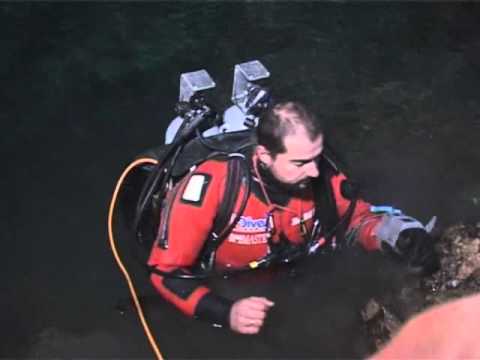
Tauchgang Piessling Ursprung
All 3 videos and posts
Videos and posts
From other divers, via YouTube, Instagram and Facebook. They only load when you click; after that, Google's or Meta's privacy rules apply.
- Facebook
ooe.gv.at
- Facebook
villabergzauber
Search for more onYouTube ↗Instagram ↗Facebook ↗
Other people's footage, not advice: how someone else dives here says nothing about what suits your team. Dive within your training.
The dive
The Pießling-Ursprung is the region's largest karst spring, fed by the Warscheneck plateau (94 km²): ~2,200 l/s on average, up to ~40,000 l/s during snowmelt or floods.
1 earlier accident or incident has been reported at this cave. Read what happened ↓
Profile and sections
The Pießling-Ursprung is the region's largest karst spring, fed by the Warscheneck plateau (94 km²): ~2,200 l/s on average, up to ~40,000 l/s during snowmelt or floods. Visibility is 30–50 m in winter, 6–8 m after floods.
The first dives were in 1962 (to -52 m). Since the double fatality of 1987 a strict diving ban applies; in 2012 the first official dive in 25 years took place under permit. The spring has been a Naturdenkmal since 1978.
- Depth and profile
- Spring pool -32 m · S1: constriction at -50/-52 m, underwater passage to ~-80 m; in 2012 ~405 m dived to -87 m (explored to -84 m according to the VHO) · S2 (at the end of the dry cave, 500 m behind the entrance): 64 m / -32 m (2002), 120 m / -40 m according to Wikipedia; according to the VHO 40 m deep and ending at a collapse, divable only as research with a large team of porters · ~1,500 m of cave known
- Configuration
- Not applicable while the diving ban applies. Water ~4 °C and a strong upward flow.
- DPV: Not DPV-suitable
- Diving ban.
Who can dive where
- At least Full cave
- Configurations: Backmount / twinset / Sidemount / CCR / Small cylinders / no-mount (speleo sumps)
- Goes down to 87 m (trimix or deco may be needed)
- Experienced divers only
This is how the planner decides who in your team may dive this cave. Rules your own trip adds (organizer, a mail, the AI) show with your trip.
How to get there
Spring pool in southern Roßleithen at 710 m. Diving in the pool is prohibited. Researchers reached sump II at the back of the system by inflatable boat across the pool and ~1 h of crawling and climbing through dry cave.
Around Pießling-Ursprung
Fills3 fill stations · nearest 57 km
ATS DiveCenter Seefeld (Steinbach am Attersee)
Seefeld 14, 4853 Steinbach am Attersee
Air, nitrox and trimix (per Upper Austria's tourism website; not on its own website) — ask
By appointment only
Centre for technical and rebreather diving (IANTD Diamond Facility) at Gasthaus Föttinger, on the east shore of the Attersee: rebreather courses (JJ-CCR, iQsub XCCR and FX) from recreational to trimix, crossovers and test days, and servicing of rebreathers, regulators, heating and scooters. Second address: ATS DiveBase, Haslach 4, Steinbach am Attersee.
Under Pressure Divecenter (Weyregg am Attersee)
Landeroith 1, 4852 Weyregg am Attersee
Air and nitrox (EAN28, 32 and 36) to 220 bar, trimix, oxygen up to 100 % and helium; argon on request
Apr–Oct Tue–Sun 9:00–18:00; Nov–Mar Thu–Sun 9:00–17:00; open on public holidays. Closed for the company holiday 7–31 January. Groups also by appointment.
Dive base on the east shore of the Attersee, open all year, with shop, fill station for technical gases and service workshop. Technical courses (TDI) from Intro to Tech to Advanced Trimix, and sidemount up to Tec Sidemount. Rooms at the base.
Nautilus Tauchcenter (Unterach am Attersee)
Atterseestraße 86, 4866 Unterach am Attersee
Air (also 24/7 at the outdoor fill station), nitrox, trimix and argon; O₂ and pressure (200/300 bar): ask
May–Sep daily 9:00–18:00; Oct daily 9:00–18:00 (16–31 Oct weekends only); Apr and Nov Fri 14:00–18:00, Sat–Sun 9:00–18:00; Dec–Mar by appointment. Outdoor station (air) 24/7.
Dive centre right on the Attersee with shop, repairs, rentals, technical training and rebreather support. Trimix for visitors: ask in advance.
Caves nearby4 within 49 km
News
All (1)
Accidents and incidents
What happened at this cave before, with the sources. No names are given; read it as a lesson for your own planning.
- October 1987: a diving instructor did not return from the sump; the next day a gendarmerie diver drowned during the rescue attempt (entangled in the line, ~-30 m) and another rescue diver suffered severe decompression sickness. The body was only recovered in 1993.
Access and rules change: check what applies locally right before your trip. Source: GDELT Project and the news feeds of diving magazines. Search for more news ↗ Searched automatically, last on 13 Nov 2026.
More of the latest in Austria: conditions, closures and news →Going to Austria with your team?
Marcel finds the sites that match your team's certifications.
Plan a trip