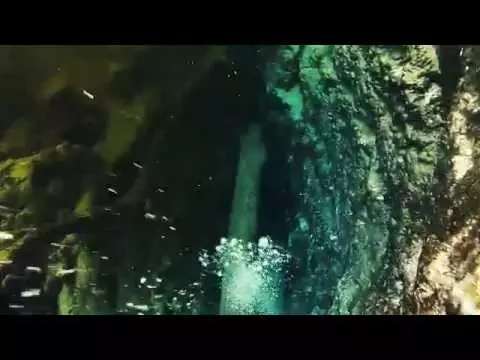
In the US cave diving is mostly about Florida, and mainly the north: the springs around High Springs, Fort White and Luraville along the Santa Fe and the Suwannee, with outliers to Marianna in the Panhandle and to central Florida. You dive clear limestone springs and sinkholes at about 22 °C, from open water and wide caverns to long, deep cave systems such as Eagle's Nest, and dive shops with trimix, camping and cabins sit right next to the springs. Further afield, Missouri has the cold, deep Roubidoux Spring in Waynesville, while almost all other well-known inland caves outside Florida are closed or for researchers only; Hawaii adds lava tubes and caverns in young lava, dived by boat with local dive centres from open water level. In winter, manatees gather in the warm water of Blue Spring in central Florida.
A classic entry at Ginnie Springs with a cavern from cavern level, camping next to the water and a brown river layer above Devil's Ear you won't forget.
A deep full cave target down to 94 m in a hunting area: only for experienced trimix divers. Sort out the online FWC registration and a day pass beforehand.
One of the few public full-cave springs outside Florida: free after checking in at the 911 centre, but cold, with strong flow at the entrance and already ~43 m deep just past it.
Open-water divers may not carry lights in the state parks, and 'grim reaper' signs stand at the entrances: this is how Florida keeps untrained divers out of the overhead. Grates close off the most dangerous parts, such as in the Ginnie Ballroom and Vortex.
Every spring has its own rules. In the state parks you show your certification, sign in, never dive solo and finish 1 hour before sunset. Ginnie, Blue Grotto, Devil's Den and Vortex are private dive parks with their own hours and rates; Cow Springs is for NSS-CDS members only.
Scooters are banned at Peacock, Lafayette Blue, Ichetucknee and Blue Spring, among others, but allowed at Ginnie, Little River and Manatee.
After heavy rain the Suwannee and Santa Fe push brown, tannic water into the river caves. Telford is 'first to blow, last to clear', and Peacock is often dark in the wet winter.
Spring water is about 22 °C year-round around High Springs and Luraville, and 19–21 °C around Marianna. Blue Spring (Orange City) closes from 15 November to 15 March for the manatees; keep 15 m away everywhere.
Tips for safe and enjoyable diving
Check the USGS gauges on the Santa Fe and the Suwannee before your dive day. When the rivers are high, pick the Ginnie Ballroom, Manatee, Blue Grotto, Devil's Den or the Marianna caves.
You can fill trimix and O₂ in High Springs, Fort White, Luraville and Marianna. Order trimix in advance in Marianna; personal compressors are banned at Ginnie.
In an accident, call 911. The DAN emergency line +1 919 684 9111 (24 h) arranges the nearest available chamber; options in the Panhandle are few.
If you dive Eagle's Nest, wear fluorescent orange on hunt days and check the FWC hunt calendar.
Plan a rest day in open water: the wreck of the Madison in Troy Spring, Devil's Den, the Ginnie Ballroom or Blue Grotto. December and January are the quietest months at the springs.
Estimates for planning, always check locally · Disclaimer
What it looks like
One video or post per cave; each cave's page has more.
Prices per cu ft online (e.g. 18/45 $2.04, 10/70 $3.15, O₂ $0.50; CCR O₂ min. $6). Rentals: backmount/sidemount doubles $14/day, trimix bailout cylinder $16, SUEX scooter $85/day, Shearwater computers. Cave courses from cavern to full cave and CCR cave (TDI, IANTD, NSS-CDS) by the owner's BJL Diving, and guided cave and spring dives, also with scooter, CCR, trimix and stages.
18481 High Springs Main Street, High Springs, FL 32643
Fills
Air, nitrox, O₂ and trimix · Daily 8:00–18:00
Training
Cavern, Intro to cave, Full cave, Sidemount, CCR, Trimix · GUE, NSS-CDS, TDI, PADI, NAUI, IANTD
Rental
Singles, stages and doubles, regulators, backplate/wing, lights and scooters
Tech and cave shop since 1995. Rents singles, stages and doubles (steel/alu, air, nitrox or mix), regulators, backplate/wing, lights and scooters; training.
Ginnie Springs Outdoors (in the park), near High Springs, FL
Fills
Air and nitrox 32 % · Park hours: Mon–Thu 8:00–17:00, Fri–Sat 8:00–19:00, Sun 8:00–18:00. Last fill between 15:00 and 17:00, depending on the fill technician's availability
Rental
Cylinders (incl. nitrox steel 85), BCs, regulators, suits and lights
Rents cylinders (incl. nitrox steel 85), BCs, regulators, suits and lights. Personal compressors are banned in the park.
SSI dive centre in the middle of Williston, within three miles of Blue Grotto and Devil's Den. Guided dives and training at springs across the area, from Try Scuba to full cave and Extended Range (sidemount, doubles or rebreather). Park behind the shop, entering from 1st Street.
Pontoon to Twin Caves and Hole in the Wall, scooters for Jackson Blue
Edd Sorenson's cave centre on Merritt's Mill Pond: CCR service and training up to CCR cave, guided dives, pontoon rental to Twin Caves and Hole in the Wall, scooter rental for Jackson Blue, lodging via Karst Kottages. Fills while you wait. The fill prices on the older website (air $5 single / $10 doubles, nitrox $0.11/cu ft) are probably outdated.
Air, nitrox EAN32 and EAN50, O₂, helium · Fill station Wed–Sun 8:00–17:30
Cave diving centre ~2.7 km from Peacock Springs, with cabins and campsites. Prices online (air $8, EAN32 $0.20/cu ft, O₂ $0.63/cu ft, trimix $1.95–3.75/cu ft). Walk-in: call via the walkie at the door and only unload when told; hydro and visual inspection must be current.
Cave instructor (TDI and PSAI, Full Cave and Tec) from Niceville. Does almost all his cave training at Merritt's Mill Pond or nearby, sometimes around Peacock. Also recreational and technical courses.
PADI dive centre close to Roubidoux Spring (training, gear, travel); Visit Missouri names it as the address for information and supplies. Fills, nitrox, trimix and rentals: ask.
Boat trips to the Cathedrals off Lanai, ~45 minutes from Mala Ramp (Lahaina), Monday to Saturday at 6:45 am. Requirements: certified divers aged 14 and up, Open Water at least and a dive in the last 18 months.
Dives First and Second Cathedral off Lanai most weekdays. Check-in at Mala Boat Ramp in Lahaina, Monday to Friday; the crossing takes ~40 minutes. Two tanks in ~5.5 hours, up to 60 minutes per dive, max 10 divers with 1 guide per 5. An AL80 as standard, Nitrox 32% or a steel 100 as extras; the Lanai dives mostly go to 15–23 m. Private and semi-private charters on weekdays too.
Dive shop in Honolulu with a second location at Waianae Small Boat Harbor on the west side, where the guided boat dives to the Makaha lava tubes leave from. Supports technical diving, with rebreather parts and services.
Dive centre in Kailua-Kona with boat dives along the Kona coast, including the lava tubes of Suck 'Em Up and Skull Cave, Kaiwi Point and Golden Arches. Also names Long Lava Tube, Casa Cave, Henry's Cave and Black Hole among others, without description.
Dive centre in Kailua-Kona with guided dives through lava tubes, arches and caverns. Requirements per its own site: Open Water; a Cavern specialty recommended but not required for simple swim-throughs; a primary and a backup light are essential.
Dive operator and boat charter in Honolulu that runs from the Hawaii Kai marina to Spitting Caves and Sea Cave and describes both sites on its own website. Fills, rental and courses: ask.
The links to Booking.com are affiliate links: if you book through one, DiveTripPlanner earns a small commission. You pay the same.
Practical info: rules, fills and emergency numbers
Florida
Emergencies
Call 911. DAN emergency line +1 919 684 9111 (24 h) arranges the nearest available chamber. UF Health Shands Hospital, 1600 SW Archer Rd, Gainesville FL 32608 (+1 352 265 0111): monoplace chambers, with 24/7 emergency access according to a 2025 overview; the UF Health Wound Care and Hyperbaric Center (Magnolia Parke, +1 352 265 4450) lists only Mon–Fri 8:00–17:00 — let DAN confirm. Panhandle: few options; an undated FAU list names Bay Medical Center Panama City (+1 850 747 6950), but the 2025 overview says hospitals there now do wound care only.
Access and rules
State parks (Peacock, Madison Blue, Lafayette Blue, Manatee, Ichetucknee, Troy, Blue Spring): show proof of certification or leave it visible on the dashboard (Blue Spring: no digital copies), sign in or register, dive within your certification, min. 2 divers (no solo), finish 1 hour before sunset. Open-water divers may not carry lights. Instructors need a commercial dive permit. Scooters banned at Peacock, Lafayette Blue, Ichetucknee and Blue Spring (and at Madison Blue according to Dive Outpost); allowed at Ginnie, Little River and Manatee (Dive Outpost). Entry $4–6 per vehicle.
Private and other sites: Ginnie Springs — register by 17:00 (16:00 in winter), waiver, $28 per day for full cave divers and $36 for other certified divers, annual pass $440; intro-to-cave and above from age 18; no diving on some holiday weekends; night dives until midnight after a daylight dive; personal compressors banned. Blue Grotto, Devil's Den (reservations) and Vortex Spring ($25) are commercial dive parks. Cow Springs: NSS-CDS members with full cave only (gate code; at most four teams of three a day). Eagle's Nest: FWC registration plus a WMA permit. Jackson Blue: pass via Cave Adventurers.
Gas and fills
Fills and rentals: trimix and O₂ in High Springs (Extreme Exposure, Cave Country Dive Shop), Fort White (Amigos), Luraville (Dive Outpost) and Marianna (Cave Adventurers; order trimix in advance). Scooters for rent at Extreme Exposure, Cave Country (SUEX, $85/day) and Cave Adventurers. Lodging: camping at Ginnie Springs, cabins and campsites at Dive Outpost, houses via Cave Excursions (Luraville), Karst Kottages via Cave Adventurers.
Water and season
Rivers and 'blackwater': after heavy rain the Suwannee and Santa Fe rise and brown, tannic river water flows into the river caves. Telford is 'first to blow, last to clear'; the Peacock caves are often dark in the wet winter; Cow Springs gets backflow; a brown layer often lies over Devil's Ear. Troy Spring closes when visibility is poor. Least affected: Ginnie Ballroom, Manatee, Blue Grotto and Devil's Den; the Marianna caves are fairly flood-resistant, the Tallahassee caves very sensitive (Wet Rocks). River levels: USGS gauges Santa Fe River near Fort White (02322500), Suwannee River at Branford (02320500) and at Luraville (02320000).
Season and water: spring water ~22 °C year-round around High Springs and Luraville; 19–21 °C around Marianna (17–18 °C deeper). April–September busy with swimmers and campers; December–January quietest (Divernet). Manatees: Blue Spring (Orange City) is closed from 15 November to 15 March; the Manatee Springs main spring closes to divers in winter when manatees are present; keep 15 m (50 ft) away everywhere.
Safety
Why 'no lights': cave-diving deaths peaked at 26 in 1974. The NSS-CDS (founded 1973) put 'grim reaper' signs at cave entrances to warn untrained divers, and Sheck Exley's 'Blueprint for Survival' (1979) became the basis of the safety rules; by the early 1980s deaths had fallen below 5 a year. The light ban for open-water divers is meant to keep untrained divers out of the overhead; grates close off the most dangerous parts (Ginnie Ballroom, Vortex).
Eagle's Nest lies in a hunting area (Chassahowitzka WMA): wear fluorescent orange on hunt days and check the FWC hunt calendar (FWC +1 850 488 4676).
Getting around
Travel: for High Springs and Luraville you fly to Gainesville, Jacksonville or Orlando; for Marianna and the springs around Tallahassee to Tallahassee; for Eagle's Nest, the Weeki Wachee and Crystal River to Tampa; for Blue Spring near Orange City to Orlando. Drive times on the cave pages are from High Springs.
Rest day
Rest day: Troy Spring (wreck of the Madison, open water only), Devil's Den, the Ginnie Ballroom or Blue Grotto. In the west: snorkelling with manatees at Three Sisters Springs in Crystal River (diving only 1 Apr–14 Nov; King Spring all year, about -20 m) and the open spring of Alexander Springs in Ocala National Forest (about -8 m, certified divers, extra fee).
Missouri (Ozarks)
Emergencies
Call 911. DAN emergency line +1 919 684 9111 (24 h) arranges the nearest available chamber.
Access and rules
Roubidoux Spring: free, open all year to certified cave divers. Check in before and after diving at the 911 emergency centre on the hill next to the fire station (Route 66, east of downtown) and show your cave card; contact the Waynesville police beforehand (+1 573 336 6355). A Scuba Diving article says diving is only allowed August to March and in daylight — ask. Bennett Spring (Bennett Spring State Park, near Lebanon): only November to February, free, one group of up to six divers a day; book with the park's Nature Center (+1 417 532 3925).
Closed or restricted
National park: in the springs of Ozark National Scenic Riverways (e.g. Big, Alley, Round and Blue Spring) diving without a written permit from the superintendent is banned; permits are only given for research.
Gas and fills
Fills: Odyssey Scuba & Travel in Waynesville (227 Historic Rt 66 E) — ask about gases. Bring your own gas for trimix.
Water and season
Water: Roubidoux is ~9–13 °C (drysuit, hood, dry gloves). Visibility is 2–9 m, usually ~5 m, and drops after rain, when the flow also increases. Check the USGS gauge for Roubidoux Spring (06928440) before you go. Bennett Spring is 13–14 °C, normally clear and milky after rain; on some days the flow is too strong to go in (USGS gauge 06923500).
Getting around
Travel: the nearest airport is Springfield-Branson; St. Louis is further away. Drive times on the cave pages are from Waynesville.
Rest day
Rest day: the Route 66 strip through Waynesville, and walking and fishing along Roubidoux Creek.
Texas and New Mexico
Emergencies
911; DAN +1 919 684 9111. The nearest recompression chamber was not looked up: ask beforehand.
Access and rules
Access to the Blue Hole: you need a dive permit: 25 dollars for a week or 75 dollars for a year, sold at the Blue Hole Center or the dive shop, on showing a current certification card. Open Mon–Fri 10 am–7 pm and Sat–Sun 12–7 pm; at weekends 6 am to 12 pm is for divers only.
Gas and fills
Gas: the Santa Rosa Dive Center next to the Blue Hole fills air and rents gear; nitrox is not on the site.
Water and season
Water: the Blue Hole is 61–62 °F (16–17 °C) all year, with ~24–30 m of visibility; a 7 mm suit is the minimum. Winter is the busiest season, with many dive courses.
Safety
Altitude: the Blue Hole lies at ~1,400 m (4,600 ft): use altitude tables or your computer's altitude setting. The roads out of Santa Rosa climb to 2,100–2,400 m (7,000–8,000 ft): allow for that after your dive.
Getting around
Travel: Santa Rosa lies on Route 66 (Interstate 40) in eastern New Mexico. Jacob's Well is near Wimberley in the Texas Hill Country, Phantom Springs near Balmorhea in West Texas.
Good to know
Read this first: of the three famous springs in this area, visitors can dive one: the Blue Hole in Santa Rosa (New Mexico), and only its open pool, because the cave beneath it is sealed. Jacob's Well in Texas is closed to divers, and Phantom Springs Cave, dived to 141 m (462 ft), is for researchers with a permit only. The three lie hundreds of kilometres apart.
Hawaii
Emergencies
911; DAN +1 919 684 9111. The state's only public chamber, the Hyperbaric Treatment Center in Honolulu, was closed for some months in 2017 for lack of doctors: have your dive centre check that it works.
Access and rules
Requirements: the dive centres usually ask for Open Water (Lanai: aged 14 and up and a dive in the last 18 months). A Cavern course is recommended; bring a primary and a backup light.
Gas and fills
Gas: air and nitrox at most centres. On Oahu, Honolulu Scuba Company blends trimix and services rebreathers; elsewhere trimix or CCR support was not researched: ask.
Water and season
Water: swell and surge suck you in and out of the lava tubes; keep clear of the walls and follow the guide. Kauai's North Shore can only be dived in summer.
Getting around
Travel: Kona (KOA) on the Big Island, Kahului (OGG) on Maui for Lanai, Lihue (LIH) on Kauai, Honolulu (HNL) on Oahu. Between the islands you fly; don't fly within 18–24 hours after diving.
Good to know
Read this first: Hawaii has no cave diving in the usual sense, but plenty of lava tubes, caverns and arches in young lava, above all along the Kona coast of the Big Island, off Lanai, on Kauai and on Oahu. You dive them guided from a boat with a local dive centre, with daylight in reach; no lines.
News
News articles that mention one of the caves in this region, collected automatically and not checked by us.
Access and rules change: check what applies locally right before your trip. Source: GDELT Project and the news feeds of diving magazines.
Searched automatically, last on 22 Nov 2026.
Plan a cave diving trip: United States
Enter your team, with certifications, gas and configurations, and see right away which caves fit. With driving times from your stay, fill stations and an AI instructor who thinks along.