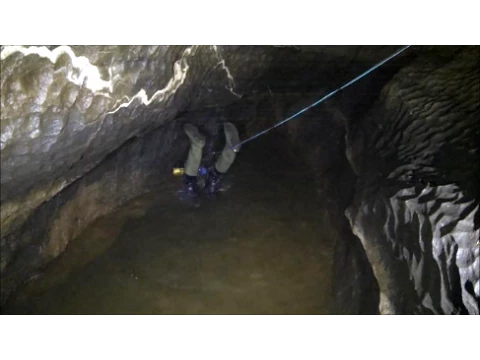
Great Britain has the birthplace of cave diving, Wookey Hole in Mendip, and its diving culture is still distinct: sidemount, a helmet and often solo, organised around the Cave Diving Group (CDG). You dive cold, tight sumps with poor visibility and flooded mines and quarries, in South Wales, the Forest of Dean and Mendip, in the slate mines of North Wales, and in the Yorkshire Dales and the Lake District. Porth yr Ogof, the Dinas silica mine and the Hodge Close slate mine are open from intro-to-cave level, while Wookey Hole and the Noxon Park iron mine are for CDG members only. Wookey Hole is also a show cave, so on a rest day you can walk through its chambers dry.
A classic Chapel-le-Dale sump to 35 m that needs no permission or CDG membership; do ask the CDG Northern Section about current conditions, and only dive after a dry spell.
Almost all sites are on private land and you need the owner's permission. The CDG knows the current arrangements; one careless visit can close a site for everyone.
Access to Wookey Hole is strictly controlled by the CDG: guests dive there only in exceptional cases, at the CDG's invitation (first contact through a CDG member or the contact form). Keld Head needs the Braida Garth farmer's permission beforehand, and it may be refused on any given day.
The CDG recommends solo diving in British sumps, because no British sump allows unimpeded buddy diving. Expect many branch lines; sidemount, helmet, hand-held lights and permanent 4 mm lines are the norm. Only dive this way if you are trained and experienced for it.
In sumps the water is rarely above 7 °C and often around 4 °C, with 1–2 m visibility as normal. The mines usually have much better visibility.
BCA membership includes public liability insurance. Forest of Dean permits are issued to BCA members only.
Tips for safe and enjoyable diving
Only dive after a dry spell. Porth yr Ogof turns into a raging river after rain, Hurtle Pot floods dramatically in spate and Keld Head needs weeks of dry weather for good visibility.
Gas in the south: Vobster Quay and Cardiff Scuba (trimix with at least 3 hours' notice). In the north: Capernwray Diving Centre and a shop in Manchester. No trimix fill station is known in the Neath valley: bring O₂ and diluent.
Emergency: call 999 or 112. For an accident in a cave or mine, ask for the police and say it is a cave rescue. For a diving accident on land: National Diving Accident Helpline 07831 151 523 (24 h).
Wales has no chamber; the nearest are Plymouth and Rugby for the south, and Birkenhead and Hull for the north.
Rest day: Porth yr Ogof is also a popular dry caving trip, and Wookey Hole is a show cave.
Estimates for planning, always check locally · Disclaimer
What it looks like
One video or post per cave; each cave's page has more.
Cromhall Quarry, Wotton Road, South Gloucestershire GL12 8AA
Fills
Air, nitrox, oxygen and 'mixed gas' · Workshop Wed, Thu, Sat and Sun 8:00–15:00
Dive lake in a former quarry (max -17 m) with a technical department (IDEST-certified) for fills, servicing and cylinder testing; the workshop is by the quarry entrance. Diving at weekends, no solo diving. Not a dive school. No phone number or e-mail address on the website: contact through the form.
29 Castle Drive, Dinas Powys, Vale of Glamorgan CF64 4NP
Fills
Air 232 and 300 bar, nitrox up to 99 %, trimix · According to the website Mon, Tue, Thu and Fri 9:00–18:00, Wed 9:00–17:00, Sat 9:30–17:30. Order trimix at least 3 hours ahead
Dive school with a fill station; nitrox only with certification. Trimix is charged per litre of helium and oxygen plus an air fill. The nearest known trimix address for the Welsh sites.
Air, nitrox 32/36/50/80 % and 100 % O₂, trimix 21/35, 18/45 and 10/70 · Members only, with pre-booking
Open quarry (max -36 m) with wrecks and the old crushing works, and according to divernet an 18 m tunnel; handy for a check-out dive. Cylinders need a valid test; nitrox and trimix only with certification and an oxygen-clean cylinder. Own compressors and solo diving are banned. Whether non-members can drop in just for fills: ask.
Unit 13 Enterprise Centre Two, Chester Street, Stockport SK3 0BR
Fills
Air and nitrox · Tue, Thu, Fri 10:30–17:00, Wed 10:30–18:00, Sat 10:30–16:30
Dive shop with a service centre off the M60 in Stockport (Greater Manchester), about 1 h 20 by car from Llangollen. Fills air and nitrox and also names 'other gas mixes'; also cylinder testing and regulator servicing.
Air, nitrox and trimix · Summer: Tue–Fri 10:00–17:00, Sat–Sun 9:00–17:00
Rental
Dive equipment
Inland dive site (quarry) with dive shop, rental, fills and café; its 'cave' is a shipping container, not real overhead. Also the fill address for Hodge Close (air and nitrox).
The links to Booking.com are affiliate links: if you book through one, DiveTripPlanner earns a small commission. You pay the same.
Practical info: rules, fills and emergency numbers
Ireland and Northern Ireland
Emergencies
112 or 999; at sea ask for the Coast Guard, after a cave accident the police, who alert the Irish Cave Rescue Organisation (ICRO). Hyperbaric chamber: University Hospital Galway, only "when staffed"; no chamber is confirmed in Northern Ireland. British diver emergency line (BHA, 24 h): 07831 151 523.
Access and rules
Access: the Speleological Union of Ireland (caving.ie) advises always asking the landowner for permission and keeps a list of access rules per cave. Only members of the Irish and British caving bodies get into the Marble Arch caves (Fermanagh), after an agreement with the Marble Arch Cave Centre; Poll na gCéim is closed by its landowner.
Water and season
Flood of July 2025: a landslide in the Cladagh Glen closed the Cascades and the glen walk (still closed in Sep 2026); boulder chokes in Pollnagollum of the Boats and Shannon Cave moved.
Getting around
Travel: the caves are spread out: Pollatoomary near Westport (Mayo), the Burren and Doolin in Clare, Coole near Gort (Galway) and the caves of Fermanagh and Cavan around Blacklion and Enniskillen, across the border.
Good to know
No provider: in Ireland and Northern Ireland cave diving is expedition work, mostly by British divers of the Cave Diving Group. We know no dive centre, guide or club that takes visitors into a cave; that is why every cave here is listed as information.
South Wales and Mendip, Great Britain
Emergencies
999 or 112. Accident in a cave or mine: call 999, ask for the police and say it is a cave rescue. Diving accident on land: National Diving Accident Helpline 07831 151 523 (24 h, England and Wales) or the nearest BHA chamber; DAN Europe +39 06 4211 5685.
Chambers (the BHA list has none in Wales): DDRC Healthcare, Plymouth Science Park, Research Way, Derriford, Plymouth PL6 8BU, tel. 01752 209999, category 1 (~2 h 30 from Chepstow). Midlands Diving Chamber, Hospital of St Cross, Barby Road, Rugby CV22 5PX, tel. 01788 579555, emergency 07931 472602, category 2: no critically ill patients (~2 h).
Access and rules
Access: almost all British cave-diving sites are on private land and you need the owner's permission; the Cave Diving Group (CDG) knows the current arrangements. One careless visit can close a site for everyone.
CDG: the British cave-diving club, with a Somerset Section and a Welsh Section. Only CDG members dive in Wookey Hole and in the caves and mines of the Forest of Dean (Noxon Park). Make first contact through a CDG member or via 'Cave Access' on the CDG contact form. Exceptions to the CDG route: Porth yr Ogof (no permit needed; the National Park Authority manages the entrances and the car park), Dinas (no formal permission needed according to TDI; owner Natural Amenities Ltd).
Insurance: BCA membership (caving member £32 a year) includes public liability insurance. FoDCCAG issues Forest of Dean permits to BCA members only (permits@fodccag.org.uk).
Gas and fills
Gas: Vobster Quay (air, nitrox, trimix, O₂; max 232 bar) and Cardiff Scuba in Dinas Powys (air to 300 bar, nitrox up to 99 %, trimix with at least 3 hours' notice). No trimix fill station is known in the Neath valley itself: bring O₂ and diluent.
Water and season
Water and visibility: in sumps rarely above 7 °C and often around 4 °C, with 1–2 m visibility normal and 3–4 m exceptional (CDG); InDEPTH gives an average of 7–10 °C. The Dinas and Noxon Park mines are ~7 °C with usually (very) good visibility.
Floods: Porth yr Ogof turns into a raging river after rain; in Wookey Hole floods leave debris, buried lines and silt banks.
Safety
Cave diving in the UK is a branch of caving, not of sport diving. The sumps are dived through the Cave Diving Group (membership and training). These pages are not an invitation to go on your own.
British practice: the CDG recommends solo diving in British sumps because no British sump allows unimpeded buddy diving; expect many branch lines (in one example 10 in the first 500 m). Sidemount, helmet, hand-held lights and permanent 4 mm lines are the norm.
Getting around
Travel: the nearest airport is Bristol, for both the Mendips and South Wales; drive times on the cave pages are from Chepstow.
Rest day
Non-diving day: Porth yr Ogof is also a popular dry caving trip (over 30,000 visitors a year); below its exit lies the Blue Pool, a small lake fed by rapids, and downstream an attractive walk passes several waterfalls. Wookey Hole is a show cave.
Good to know
Inland dive centres: NDAC near Chepstow closed permanently on 18 February 2022; the NDAC quarry near Ammanford (124 m deep) is for training organisations only. Vobster Quay (Somerset) is an open quarry to -36 m, members only; non-members on Tuesdays 8:00–15:00 after registering.
North Wales, Great Britain
Emergencies
999 or 112. Accident in a mine or cave: call 999, ask for the police and say it is a cave rescue; cave rescue is free in the UK (TDI). In North Wales that is the North Wales Cave Rescue Organisation. Diving accident on land: National Diving Accident Helpline 07831 151 523 (24 h, England and Wales) or the nearest BHA chamber; DAN Europe +39 06 4211 5685.
Chamber: Hyperbaric Treatment & Training, 2 East Street, Birkenhead CH41 1BY, tel. 0151 648 8000 (24/7; backup 07802 824245), category 1 (~1 h from Llangollen, ~2 h from Croesor; estimate).
Access and rules
Access: according to TDI all underground sites in the UK have access requirements. Some are open access, some need BCA (British Caving Association) membership with BCA diving insurance, your public liability insurance, and you apply for access in the way the landowner asks. Aber Las: BCA membership and the landowner's permission through UKMC. Cambrian: open according to TDI (2019, updated 2021), with no formal permission. Croesor: no access rule published, and only reachable with a decent 4x4 (UKMC).
Gas and fills
Gas: our sources name no fill station near Llangollen or Croesor: arrange your gas in advance.
Water and season
Water and visibility: in Cambrian ~7 °C, with 10–15 m visibility that drops to 2–3 m after rain; in Aber Las visibility is usually very good, except at the dive base and on the way out (TDI).
Safety
Safety: TDI advises all mine divers to leave a callout time with someone they trust on the surface, who raises the alarm if you are not back on time.
Getting around
Travel: the nearest airports are Manchester and Liverpool; drive times on the cave pages are from Llangollen.
Rest day
Non-diving day: the Pontcysyllte Aqueduct over the Dee, the castle of Castell Dinas Brân above Llangollen, and near Croesor the Llechwedd Slate Caverns and the Ffestiniog Railway.
Good to know
Read this first: in North Wales you dive dark, flooded slate mines with complex navigation. UKMC (UK Mine Cave group), a club of mine and cave divers, explored and lined Aber Las and gives its members location maps, access agreements, dive maps and surveys. These pages are not an invitation to go on your own.
Yorkshire Dales, Great Britain
Emergencies
999 or 112. Accident in a cave: call 999, ask for the police and say it is a cave rescue. Diving accident on land: National Diving Accident Helpline 07831 151 523 (24 h) or the nearest BHA chamber; DAN Europe +39 06 4211 5685.
Chambers: Hyperbaric Treatment & Training, 2 East Street, Birkenhead CH41 1BY, tel. 0151 648 8000 (24/7; backup 07802 824245), category 1 (~1 h 45 from Ingleton). North of England Medical Hyperbaric Unit, Spire Hull and East Riding Hospital, Lowfield Road, Anlaby, Hull HU10 7AZ, tel. 01482 659471 (hospital switchboard), category 1 (~2 h 15).
Access and rules
Access: the Council of Northern Caving Clubs (CNCC) publishes access rules per cave (cncc.org.uk). Keld Head: permission from the farmer at Braida Garth (may be refused on any day), carry your CDG card and preferably go with a local CDG member. Hurtle Pot: no permission needed. Joint Hole: closed. Hodge Close: goodwill parking fee, no formal permission.
CDG Northern Section: ask about access and conditions beforehand. Overseas cave divers can only get temporary CDG membership.
Insurance: BCA membership (caving member £32 a year) includes public liability insurance; clubs such as UKMC use it to cover landowners.
Gas and fills
Gas: Capernwray Diving Centre near Carnforth (air, nitrox, trimix; ~25 min) and The ScubaDiving Gear Store in Manchester (technical nitrox, O₂, trimix; ~1 h 15).
Water and season
Water and visibility: Keld Head ~7 °C and peat-stained, good visibility needs weeks of dry weather; Hodge Close 4–6 °C and usually clear. In sumps rarely above 7 °C, with 1–2 m visibility as normal (CDG).
Floods: in Chapel-le-Dale the Weathercote shaft can fill to the top in spate and Hurtle Pot then floods dramatically — dive only after a dry spell.
Safety
Cave diving in the UK is a branch of caving, not of sport diving. The sumps are dived through the Cave Diving Group (membership and training). These pages are not an invitation to go on your own.
British practice: the CDG recommends solo diving in British sumps because no British sump allows unimpeded buddy diving. Sidemount, helmet, hand-held lights and permanent 4 mm lines are the norm.
Getting around
Travel: the nearest airports are Manchester and Leeds Bradford; drive times on the cave pages are from Ingleton.
Scotland (Appin and Assynt)
Emergencies
999, ask for the Police and then Mountain Rescue, who call out the Scottish Cave Rescue Organisation. The nearest recompression chamber was not looked up: ask beforehand.
Access and rules
Access: according to the CNCC no permission is needed for sport caving in Appin; most caves there lie in forestry plantations. Be courteous to the landowners and don't block gateways. Uamh an Claonaite lies in a protected site (SSSI) and the bones in the cave are protected: leave new finds where they are and report them.
Gas and fills
Gas: there is nothing at the caves. Puffin Dive Centre in Oban, ~30 km from Appin, fills air and nitrox; for Assynt no source names a fill station: bring filled cylinders.
Water and season
Water and weather: both caves flood in rain. In the Cave of Skulls the entrance crawl and the pitches are 'sporting or impassable' in wet weather; in Uamh an Claonaite sumps and passages can become impassable and in very wet conditions the cave cannot be entered at all.
Getting around
Travel: Appin lies on the west coast between Oban and Fort William; Assynt lies in the north-west, north of Ullapool. Between the two it is half a day's drive.
Good to know
Read this first: Scotland has no guided cave diving. What it has are short, cold sumps deep inside caving trips: in Appin (Argyll) the Cave of Skulls, in Assynt (Sutherland) Uamh an Claonaite, the longest cave in Scotland. You only get there as a caver, with rope or ladder work, and the dives are the work of the clubs' cave divers.
Peak District, England
Emergencies
999 or 112: ask for the police, then cave rescue. Rescue through Far Sump is difficult.
Access and rules
Access: the sumps lie deep inside the cave system under Castleton and are dived only by cave divers of the caving clubs, as long-term projects. Access for divers was lost in the early 1970s and arranged again in 1979.
Gas and fills
Gas: no fill station found near these caves.
Water and season
Water: no source gives the temperature, visibility, length or depth of the sumps.
Getting around
Travel: Castleton is in the Peak District, between Manchester and Sheffield.
News
News articles that mention one of the caves in this region, collected automatically and not checked by us.
Access and rules change: check what applies locally right before your trip. Source: GDELT Project and the news feeds of diving magazines.
Searched automatically, last on 22 Nov 2026.
Plan a cave diving trip: United Kingdom
Enter your team, with certifications, gas and configurations, and see right away which caves fit. With driving times from your stay, fill stations and an AI instructor who thinks along.