
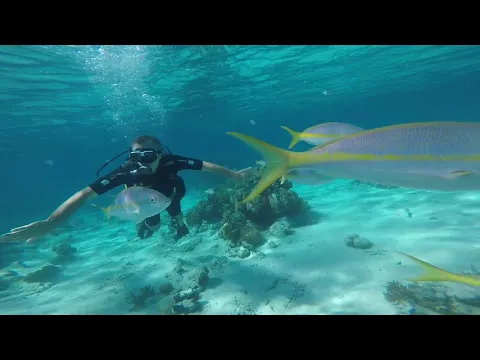
5 cenotes · down to 70 m (230 ft) · 5 suitable for an intro team
Cave diving in Cuba
- Cenotes5
- Max depth70 m (230 ft)
- Water temperature23–30 °C (73–86 °F)
Why come here
Cuba is not a cave-diving destination in the usual sense: Cuban law only allows cavern diving, in daylight, to 40 m, with at most 60 m of penetration and at least 12 m of visibility, after case-by-case approval by the Comisión Nacional de la Náutica and always led by an instructor of a licensed dive centre. Decompression dives and dives below 40 m are prohibited. What you can do here is guided cavern diving in remarkable cenotes: those of Zapata on the Bay of Pigs, with Playa Larga as the base, Cueva de Saturno near Varadero and Tanque Azul near Gibara. In the cenotes fresh water lies over salt water, with a halocline; the sea is 23 °C in winter to 30 °C in summer.
There is mostly only air, no trimix, so bring your own cave gear. DAN lists no recompression chamber in Cuba, and in 2026 there were fuel and power shortages: only go once you have checked that this is still the case.
Don't miss
- Cueva de los Peces (Playa Girón): Cuba's best-known cenote: a long, narrow cleft with crystal-clear water, where you see tropical fish and coral against a backdrop of stalactites.
- Tanque Azul (Caletones, Gibara): according to Cuban sources the largest flooded cave in the country, with clear bluish water, stalactites, orange formations and blind fish; whether, and with which centre, you can dive it now is not confirmed.
- Cueva de Saturno (Varadero): a freshwater cenote near Varadero with stalactites, blind cavefish and shrimp.
On a rest day
- Cuevas de Bellamar: A dry show cave 2 km south of Matanzas, found by quarrymen in 1861, with a guided tour past stalactites, stalagmites and crystal domes.
- Laguna del Tesoro: Take a boat to the Aldea Taína, a reconstructed Taíno village on an island in the lagoon in the Ciénaga de Zapata, with statues by Rita Longa.
- Museo Girón: The small museum in Playa Girón about the Bay of Pigs invasion.
All 5 cenotes
| Site | Max depth | Type | Certification |
|---|---|---|---|
| Casimba del Brinco (Playa Larga)Permission neededBackmount · Cavern | – | Backmount | Cavern |
| Cueva Azul (Punta Francés, Isla de la Juventud)Backmount · Cavern | 45 m (148 ft) | Backmount | Cavern |
| Cueva de los Peces (Playa Girón)Permission neededBackmount · Cavern | 70 m (230 ft) | Backmount | Cavern |
| Cueva de Saturno (Varadero)Permission neededEntry or dive feeBackmount · Open water / no overhead | 20 m (66 ft) | Backmount | Open water / no overhead |
| Tanque Azul (Caletones, Gibara)Permission neededBackmount · Cavern | 18 m (59 ft) | Backmount | Cavern |
Certification requirements, configurations and trimix depths are estimates for planning. Always check them locally and dive within your training.
Map
Practical info: rules, fills and emergency numbers
Emergencies
- Police 106, ambulance 104, fire 105. DAN lists no recompression chamber in Cuba in its network (2023 and 2026); the dive centre is required to name the nearest chamber in its emergency plan, so ask. Travel insurance with medical cover is required on entry.
Access and rules
- Read this first: Cuba is not a cave-diving destination in the usual sense. The diving regulation (Resolución 48/2014 of the Ministry of Tourism) only allows 'buceo en cavernas': in daylight, to 40 m, up to 60 m of penetration and with at least 12 m of visibility, and even that only after case-by-case approval by the Comisión Nacional de la Náutica. Every tourist dive is guided by an instructor of a licensed dive centre; diving on your own is not provided for. Decompression dives and dives below 40 m are prohibited. What you can do here is guided cavern diving in remarkable cenotes, not the passages beyond.
- Permission: the Zapata coast has been a protected area since 2006 (Sistema Espeleolacustre de Zapata, 2010) inside the Ciénaga de Zapata biosphere reserve. Ask the dive centre to arrange the approval for the cavern dive; the park's rules for divers are not published.
Gas and fills
- Gas: air; nitrox is rare and there is no trimix. Under the regulation cylinders are filled to 225 bar at most. Bring your own cave gear (lights, reels): the centres have at most gear for their instructors.
Water and season
- Water: sea 23 °C in winter to 30 °C in summer; the cenotes have fresh water over salt water, with a halocline. Hurricane season June–November.
Getting around
- Location: the Zapata cenotes lie along the coast road between Playa Larga and Playa Girón on the Bay of Pigs, ~3 h drive from Havana (estimate). Cueva de Saturno is near Varadero airport. Tanque Azul is on the north coast of Holguín near Gibara, ~70 km from Guardalavaca. Punta Francés belongs to Isla de la Juventud (plane or boat from the mainland). Reef caves and tunnels through the reef wall are found at Punta Francés (over fifty dive sites, from caves to tunnels; arranged through Marina Siguanea) and at Punta Perdiz near Playa Girón (many small caves and swim-throughs on the drop-off), only through the licensed dive centres.
- Practical (2026): fuel only through an app and at most 20 litres per fill, rental cars included; power cuts of many hours a day and repeated nationwide blackouts; Visa and Mastercard were suspended in June 2026 (one source) — bring cash (euros). Only go once you have checked this is still current.
Rest day
- Rest day: the Cuevas de Bellamar near Matanzas (dry show cave, ~3 km) and a boat trip on the Laguna del Tesoro in the Ciénaga de Zapata.
Good to know
- US citizens: travel to Cuba as a tourist is prohibited for US citizens; only under an OFAC licence.
News
No recent news found about the caves in this region.
Searched automatically, last on 5 Nov 2026.
Going to Cuba with your team?
Marcel finds the sites that match your team's certifications.
Plan a trip