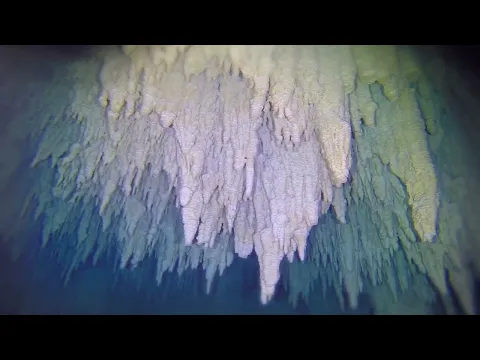
Mexico means cenotes: collapsed holes in the flat limestone of the Yucatán peninsula that lead into huge underwater cave systems. On the Riviera Maya, around Playa del Carmen and Tulum, the range runs from guided cavern tours and shallow caves at intro-to-cave level to remote full cave systems, plus Cozumel; the water is warm and clear, and most caves are shallow and richly decorated. Around Mérida, in Yucatán state, it is a different kind of diving: deep cenotes that drop as vertical pits on ejido land, such as Sabak Ha and the shaft of Usil, often dived on trimix. Near Tulum, the ruins of a walled Maya city stand on the cliffs above the Caribbean.
A full cave system where beams of light fall in between March and September. With intro-to-cave you dive only its intro zone: the main line from the entrance to the first big rooms, without jumps.
Also known as Hells Bells: the bell-shaped limestone formations below the halocline are unique. It is a deep, guided dive (down to 54 m): plan your depth and gas strictly within your certification.
Cenotes are on private or ejido land and every owner has their own rules and fees, usually about 200–600 MXN per diver per day, cash in pesos. Rules change quickly.
A guide isn't mandatory for certified full cave divers, but is recommended for your first dives. Open-water divers may only join a guided cavern tour: max. 4 divers per full cave guide, daylight zone only.
Some cenotes are closed or restricted: in September 2026 Gran Cenote, Regina, Shoam and Caracol were closed, Pet Cemetery was restricted and Dreamgate was cavern only. The Tren Maya runs over dozens of cenotes; ask your dive centre about the current status.
Several caves need a key or an arrangement, for example Xa'ay Ha and Doggi via ProTec Tulum, Outland via Nohoch Nah Chich and Otoch Ha/Concha via Zero Gravity. You pay for the Muyil caves at the Diconsa opposite the ruins.
Tips for safe and enjoyable diving
Register the free CREER Cave Pass in advance (photo, cave card, nitrox card): it saves time at cenotes and rental shops.
Start early: many cenotes are only open in daytime, about 8:00–17:00. Eden/Ponderosa and Chikin Ha are closed on Saturdays. At remote cenotes, such as Muyil and along the Nohoch road, leave someone with the car.
In an accident: the SSS hyperbaric chamber in Playa del Carmen is reachable 24/7 on +52 984 188 6486 (about 25 min away). DAN is on +1 919 684 9111, or in Spanish on +52 557 100 0540.
January falls in the dry season: water around 24 °C, the best visibility and fewer crowds.
Plan a rest day at a swimming cenote such as Cristalino, Azul or Kantun Chi, or take a day trip to Cozumel for drift dives along the reef. The only cave there, Aerolito de Paraíso, is guided only.
Estimates for planning, always check locally · Disclaimer
What it looks like
One video or post per cave; each cave's page has more.
Complete dive sets (ScubaPro, Cressi), cave gear too
Resort centre on the beach of hotel Catalonia Riviera Maya, with sister bases at Allegro and Royal Hideaway Playacar. Mainly reef and cenote dives (Dos Ojos, Chac Mool); also sells a two-dive cave excursion for certified cave divers — ask beforehand which caves and which requirements. Not a tech centre.
Trimix and Sofnolime 797 for CCR · Unknown — email
Rental
Cave gear (price lists on the site)
Per their own site based at Cenote Tajma Ha (km 264, coordinates from the site). Rental of cave gear (2026/2027 price lists on the site), Shearwater, XDeep, Razor dealer. Supports independent divers. CCR: cave CCR card + unit card, shakeout dive first. info@underthejungle.com
Carretera Federal 307, Mz. 293 Lt. 1, Col. Ejidal, 77710 Playa del Carmen
Fills
Air, nitrox, oxygen and trimix · Mon–Fri 8:00–17:00, Sat 8:00–14:00, Sun closed
Training
Cavern, Intro to cave, Full cave, Sidemount, CCR, Trimix · NSS-CDS, TDI
Rental
Twinset with backplate/wing, regulators, stage rig and CCR (Dive Rite O₂ptima)
Official Dive Rite store in Mexico. Cave courses from cavern to full cave, also sidemount, stage, scooter, trimix and CCR cave. Guided cave dives on open circuit (at least Intro to Cave) and CCR (CCR Cave), at most 3 divers per guide; the centre can't guarantee specific caves in advance.
Calle 6 Norte esq. Calle Diagonal 55 Sur, Mz 12 Lt 2, Ejido, Playa del Carmen
Fills
Nitrox, trimix and oxygen · Daily 7:30–19:00
Training
GUE, IANTD, TDI
Rental
Equipment, cylinders and SUEX scooters
Recreational and technical dive centre in Playa del Carmen with gas blending, scooter rental, gear storage and classrooms; you can join local research and exploration projects there.
Dive centre in the centre of Playa del Carmen with reef, wreck and cenote dives, and cavern and cave dives in the cenotes around Tulum. TDI Cavern, Intro to Cave, Full Cave, Stage and Sidemount courses.
Guided cave dives in small groups (32% nitrox and entrance fees included); big caves such as Vaca Ha for backmount, narrower ones such as Xulo and Minotauro for sidemount.
PADI 5 Star centre in Playa del Carmen. Guided cavern tours in the daylight zone: Chac Mool, Dos Ojos and Chikin-Ha from Open Water, the others from Advanced Open Water.
Air, EAN32, O₂ up to 200 bar, trimix on request · Daily 8–19
Rental
CCR, scooters, sidemount and doubles
Rental of CCR, scooters, sidemount and double cylinders; CCR room for 14 units. ProTec Playa merged into Tulum in 2026. Keys for Xa'ay Ha (Chi Keen) and Doggi/Style (Muyil) are collected here.
Cave and tech diving school in Tulum, founded in 2024. Courses from cavern and intro to cave up to full cave, plus sidemount, cave DPV and multi-stage/cave deco; according to the InDEPTH business directory it certifies through TDI. Also runs technical diving expeditions, among them to Madagascar, Narvik and Bikini.
Air, nitrox, O₂ and helium mixes · Daily 7:30–21:00
Rental
Cave gear
Fills CCR, stage and double cylinders; cave gear for rent. Card payment accepted. The site also lists a Puerto Aventuras branch (Hwy 307 km 269.5, 7:30–21:00), but it is not on Google Maps — ask whether it exists and fills.
Training centre with guided cenote dives. Cave: Cavern, Intro Cave, Full Cave, Stage Cave, Cave DPV and Cave CCR. Tech: Intro Tech, Advanced Nitrox, Deco Procedures and Trimix (OC and CCR). Recreational: all levels. Everything at diver and instructor level, so also instructor courses, and Human Factors in Diving. Also offers accommodation for divers. No fills for visitors.
Dive centre on Isla Mujeres that runs cenote trips to the mainland from there: guided cenote dives and cavern, intro-to-cave and sidemount courses (SDI, TDI, PADI).
No fixed address on the site: call or email. Rental of JJ-CCR and Fathom MK2.5, doubles, stages (price list on the site); guided cave dives for certified divers. Gases are listed for their own tours/courses — ask about walk-in fills. a.vronski@cave-ha.com. No Google listing found.
Dive centre in Akumal: cavern, cave and sidemount courses, guided cavern and cave dives, and through Actun Pro Tulum (actunprotulum.com) instructor courses for cave and technical diving (IANTD, SSI).
Guided cave dives between Playa del Carmen, Tulum and Muyil (also stage, CCR and DPV), with pick-up at your stay in Playa del Carmen; Intro to Cave at least.
Dive centre with guided cave dives for certified cave divers, matched to level, experience and configuration (sidemount, backmount or CCR). It guides in many cenotes and cave systems of the Riviera Maya, among them Dos Ojos, The Pit, Tajma Ha, Chac Mool, Ponderosa, Carwash and Angelita, choosing the site by certification, experience, conditions and interest. IANTD Cavern, Intro to Cave, Full Cave, Sidemount, CCR and technical diving courses, led by IANTD Instructor Trainer Julien Garnier. Pick-up at your accommodation in Playa del Carmen. No fill station of its own: the centre arranges the gases through trusted local partners, mainly air and nitrox, oxygen for CCR and deco, and trimix on request. In English, French and Spanish.
Dive centre in Playa del Carmen with cavern and cave courses up to full cave, plus sidemount and CCR (IANTD, TDI). Guided cave dives only for divers with a full cave certification (or equivalent), overhead experience and good trim and gas planning. Also reef, cenote and shark dives.
Dive operation of TDI cave instructor Sebastian Fischer in the Riviera Maya, without a shop of its own: guided cavern and cave dives in the cenotes, and sea dives off Cozumel, Puerto Morelos and Playa del Carmen. TDI Cavern, Intro to Cave, Full Cave, Stage and Sidemount courses.
Bed & breakfast for cave divers with guided cavern and cave dives: up to two dives of 60 to 120 minutes a day, or one longer CCR, stage or deco dive; CCR try-dives and ISC Megalodon training.
Dive centre specialised in cave and cenote diving. Guided cave dives for certified cave divers of every level, with or without decompression and in any configuration, and daylight-zone cavern dives for recreational divers. TDI training from Cavern to Full Cave, Cave Stage and Cave Decompression. Contact through the form on the website.
TDI cave instructor in Playa del Carmen, with Ananda Divers and through Dive Rite Mexico: courses from cavern to full cave and sidemount, Intro to Tech, Advanced Nitrox and Decompression Procedures, and guided cavern and cave dives in the cenotes.
Cave, technical and CCR instructor in Tulum: courses from cavern to full cave, stage, cave DPV, sidemount, CCR (KISS Sidewinder) and trimix, also a cave survey course, and private guided cave and cenote dives.
IANTD instructor (and instructor trainer) in Playa del Carmen: private guided cavern and cave dives, and IANTD courses from cavern to full cave, stage, sidemount and technical diving, up to instructor level.
Day trips with two cenote dives from Mérida (about 3,450 MXN pp) with a cavern guide, oxygen on board and fees included; their regular cenote is Yax Há. Certified divers only.
Dive centre in the centre of Mérida with the longest public list of cenotes in the state: from Suem (6 m) to Sabak Ha (120 m) and Usil (112 m). Cavern course, sidemount and nitrox; the deep cenotes only with the right certification.
PADI centre with a cavern specialty and nitrox; guided cenote dives from Mérida including transport (about 1,500–1,700 MXN for two cenotes). Which cenotes: ask.
Guides: not mandatory for certified full cave divers (CREER), but recommended for the first dives. Open-water divers may only come along on a guided cavern tour: a full-cave guide, max. 4 divers per guide, daylight zone only. CREER rates the cavern routes from level 1 (starter) to 4 (expert). Rules differ per owner/ejido and change quickly; the Dos Ojos park (ejido Jacinto Pat) has its own guide scheme.
Register the free CREER Cave Pass in advance (photo, cave card, nitrox card): faster access at cenotes and rental shops — creer-mx.com/cave-pass
Keys/arrangements: Xa'ay Ha and Doggi closed (no key at ProTec any more); Outland via Nohoch Nah Chich; Jailhouse via a shop in Tulum (blue walls, 20.2082, -87.4669); Sac Be Ha via the owner in Tulum; Otoch Ha/Concha via Zero Gravity; Muyil caves are paid at the Diconsa opposite the ruins. At remote cenotes (Muyil, Nohoch road) leave someone with the car.
Closed or restricted
The Tren Maya (section 5) runs over dozens of cenotes; some are damaged or closed — ask your dive centre about current status.
Fees: roughly 200–600 MXN per diver per day; bring cash (pesos). Many cenotes are only open in daytime (about 8:00–17:00); start early. Eden/Ponderosa and Chikin Ha are closed on Saturdays.
Water and season
Water: about 24–25 °C all year. January: dry season, best visibility, fewer crowds. Light beams in the caverns around late morning/midday.
Getting around
Cozumel (one cave): drift dives along the reefs (Palancar, Columbia, Santa Rosa), park fee 225 MXN per person per day, cash. Only cave: Cenote Aerolito de Paraíso, guided only (via Cozumel Abyss Divers), 4.5–21 m, halocline. Ferry from Playa del Carmen about 45 min; ask whether you may bring your own cylinders — otherwise rent on the island.
Rest day
Swimming cenotes without cave diving (day off): Cristalino, Azul, Kantun Chi, Yax-Muul, Atik, Zemway, Casa Tortuga, Xcacel, Chaak Tun (snorkel tour), Aktun Chen (dry cave), Tankah, Yax-Kin, Kapen Ha, Santa Cruz, Choo-Ha/Tamcach-Ha/Multum-Ha (Cobá), Boca del Puma, Verde Lucero, La Noria, Las Mojarras, Popol Vuh.
Yucatán (Mérida)
Emergencies
Call 911. The new Hospital O'Horán in Mérida (opened May 2026) was to get a hyperbaric chamber; ask whether it is working. Certain chambers: SSS Playa del Carmen +52 984 188 6486 (about 3.5 h). DAN +1 919 684 9111 or +52 557 100 0540 (Spanish).
Access and rules
Guides: no state or federal rule found. Open-water and advanced divers may only dive the lit zone at Yax Há and Kankirixché, with a guide; the deep sections are for cave divers. Sabak Ha and Usil: technical dives only, with a qualified guide.
Fees and opening hours
Fees: 10–100 MXN per cenote, cash; Nah Yah about 50 MXN. Mostly 8:00/9:00–17:00; Sabak Ha has no ticket desk. Bring your complete gear: the cenotes rent nothing.
Gas and fills
Fills: only air and nitrox confirmed (Diving Yucatán, Mérida). Trimix, oxygen, helium and CCR support have not been found in Yucatán state: bring your gas from the Riviera Maya (Cave CCR, Zero Gravity, 3.5 h drive) or arrange it in advance with your dive centre in Mérida.
Water and season
Water: about 25–26 °C all year. The open cenotes often have a green algae layer in the top metres; below it 25–50 m visibility. Dry season November–April; hurricane risk June–October.
Getting around
Distances from Mérida: Abalá/Mucuyché about 1 h, Pixyá/Cuzamá about 1 h, Sabak Ha about 70 km via Muna, Usil (Cenotillo) about 100 km. MID airport is 5 km from the centre.
Rest day
Swimming cenotes without cave diving (day off): the Homún string (Santa Bárbara, Santa Rosa, Tza Ujun Kat, Bal Mil, Hool Kosom, Canunchén), the three of Cuzamá by horse cart (Chelentún, Chacsinicché, Bolonchojol), Sambulá near Motul, and around Valladolid Suytun, Zací, Oxman (diving banned), X'kekén and Samulá.
Rest day: Mérida itself, the haciendas of Mucuyché and Sotuta de Peón, Uxmal and the Ruta Puuc, Chichén Itzá.
Good to know
Different country from the Riviera Maya: no long, shallow, decorated systems but vertical, deep cenotes on ejido or private land around Mérida. Many sites are at -30 m within minutes and the guides prefer to dive them on trimix. No CREER rules here; each cenote has its own owner and arrangements.
Tamaulipas
Emergencies
No chamber found in the region; in the 1990s the nearest was in Galveston (Texas), at least 8 hours' drive. Ask DAN beforehand where the nearest chamber is.
Gas and fills
Gas: no fill station on site; the teams brought open circuit and rebreathers with trimix from Mexico City.
Water and season
Season: the dry season from January to April is best, because the current slows and visibility improves. Don't dive after rain.
Safety
Security: according to Nitrox (IANTD) divers are guarded by state police because of insecurity. The US gives Tamaulipas level 4, 'Do not travel' (May 2026); the Netherlands gives orange, essential travel only, except Tampico and Altamira and only by air (Oct 2026); Canada and the UK advise against non-essential travel, with exceptions for Tampico and (UK) federal highways 80, 81 and 85 and the area south of them (Oct 2026). Read the current travel advice before you go.
Getting around
Travel: fly to Tampico (TAM); there are hotels near Ciudad Mante and near the caves, all about an hour's drive. Zacatón is ~2 hours' drive from Tampico on rural roads; stay in Aldama or Tampico.
Rest day
Rest day: every evening at dusk thousands of bats fly out of the Cueva de Quintero, ~30 min from El Mante, and the El Cielo Biosphere Reserve (Unesco) has cloud forest.
Good to know
Read this first: north-eastern Mexico has some 15 known cave systems, often deep (some beyond 240 m), where Sheck Exley and Jim Bowden made their record dives in the 1980s and 1990s. There is no dive centre on site: Rango Extendido from Mexico City offers dives, and all gear comes from Mexico City.
Sierra Mazateca, Oaxaca
Emergencies
911. No hyperbaric chamber found in the region; DAN emergency line: +1 919 684 9111.
Access and rules
Access: the 2018 team needed written permission from the municipal president of Mazatlán Villa de Flores and the support of the village of Loma Grande; without that support villagers turned against the team. Arrange this well ahead and with someone who speaks Spanish.
Gas and fills
Gas: no fill station found. The teams brought rebreathers, trimix and their own cylinders and carried everything into the canyon on foot and with horses.
Water and season
Season: the expeditions dived in the dry season (March–April). Rain on the surface floods the caves within hours.
Getting around
Travel: the 2018 team took the bus from Mexico City to Huautla de Jiménez; from the field house in Loma Grande the cave is about two hours' walk.
Good to know
Read this first: beneath the Sierra Mazateca lies Sistema Huautla, the deepest cave system of the western hemisphere (1,560 m, over 100 km of passages). The sumps here lie beyond dozens of shafts and kilometres of dry cave and are dived only by large expeditions with underground camps. No source names an operator that takes visiting divers.
News
News articles that mention one of the caves in this region, collected automatically and not checked by us.
Access and rules change: check what applies locally right before your trip. Source: GDELT Project and the news feeds of diving magazines.
Searched automatically, last on 22 Nov 2026.
Plan a cave diving trip: Mexico
Enter your team, with certifications, gas and configurations, and see right away which caves fit. With driving times from your stay, fill stations and an AI instructor who thinks along.